Start Your Brag File Today: The Resume Problem Nobody Sees Coming Until the Day After a Layoff
You get laid off, open your resume, and can't remember a single number from four years of work. Ten minutes a month fixes that, but only if you start before you need it.
By Mattie · · 3 min read
Picture this. You have just been laid off. Your email access is gone. Your files are gone. You open a blank document to rewrite your resume and realize you can't remember a single concrete result from your last four years of work.
All you can write is "Managed daily operations."
I have been a recruiter for twenty years, and I have hired at Netflix, HBO and the BBC. I have read thousands of resumes, and this is the most common weakness I see: vague duties, no results. And it is almost always fixable, but only if you act before you need it.
What happens when you wait
I keep seeing people describe the same moment after a layoff. They sit down to update their resume and can only produce general statements about responsibilities. Four years of real work shrinks into a few forgettable lines.
One person I coached was saved by an old performance review they had kept. It contained a concrete detail about reducing a backlog from a big pile to a small one. That single number turned a vague bullet into something a recruiter would remember.
They were lucky. Most people do not have that review. Do not rely on luck.
The habit: a monthly brag file
A brag file is a private note where you record what you accomplished. That is it. It lives on your own device, not on your work computer, not in your company email, not in anything you could lose access to overnight.
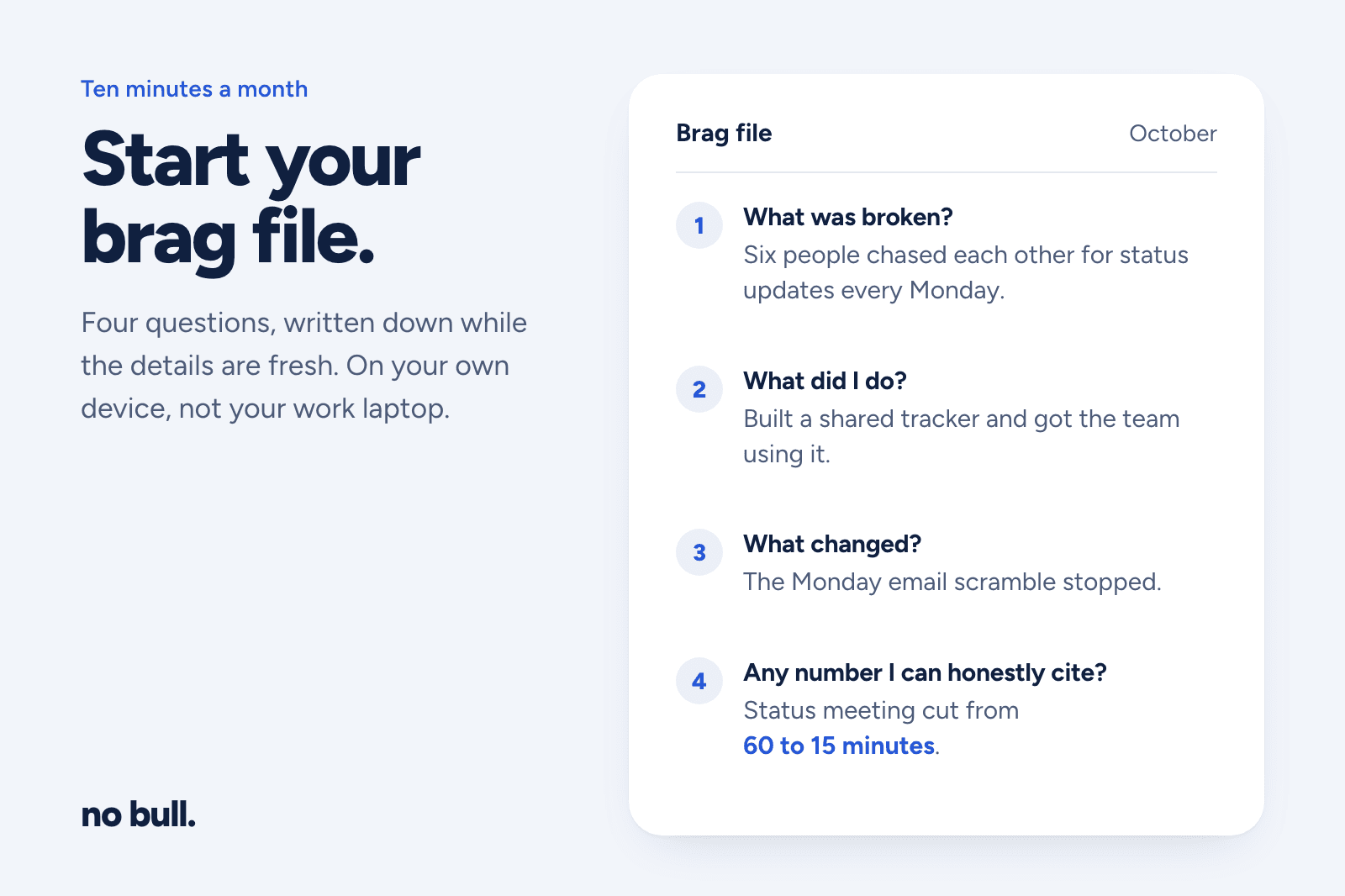
Once a month, spend ten minutes and write a few lines. Answer four questions:
- What was broken? What problem or mess did you walk into?
- What did you do? Your specific action, not the team's general effort.
- What changed? What is different now because of you?
- Any number you can legitimately cite? Time saved, items cleared, people served, errors reduced. Only use figures you actually know.
Keep it plain. These are notes for yourself, not polished prose. Future you will turn them into resume bullets.
A caution: do not copy confidential company material into your notes. Record your own contribution and the outcome in general terms. Keep it clean.
"But I don't have dollar figures"
I hear this a lot, and it is a fair worry. Many people never see revenue or budget numbers, and companies do not always share them.
Good news: you do not need dollars. Non-financial wins count, and recruiters value them. Think about what got better.
A weekly status scramble across your team disappeared because you built a shared tracker. That is a real improvement. A process that took three steps now takes one. Customers stopped asking the same question because you rewrote the instructions. New hires got up to speed faster because you organized the onboarding.
Those are results. Describe the before and the after, and add a number when you honestly have one. If you do not, a clear description of the change still beats "responsible for" every time.
The recruiter angle: update your resume quarterly
Here is the second habit I push on every job seeker I coach. Update your resume every quarter while you are employed.
Why? Because you will never write a good resume while panicking. When you are job hunting under pressure, you are tired, anxious, and rushing. You grab whatever phrases come to mind, and they are generic.
When you update calmly every few months, the details are fresh. You remember the project, the problem, the result. The resume stays current, and if a recruiter reaches out unexpectedly, or a layoff hits, you are ready in an afternoon instead of scrambling for weeks.
Your brag file feeds this directly. Each quarter, take the best entries and turn them into resume bullets. Lead with the result, then the action.
What a good bullet looks like
Compare "Managed customer requests" with "Cleared a growing request backlog by creating a triage routine the whole team adopted." The second one tells me what you did, what changed, and that others followed your lead. No invented drama, just clear impact.
That is what stands out when I am scanning a stack of resumes.
Do this right now
Don't save this for later. Open a note on your phone or computer right now. Write the date. Then write down one thing you fixed, improved, or finished this month.
That's your first entry. Set a reminder to do it again next month.
You can't predict the day your job disappears or the day a great opportunity appears. You can make sure that when either one comes, your proof is already written down.
No bull: if you can't say what you did, nobody will hire you for it. Start the file today.